
The AI Agency Shift
How the past year broke open the AI Fluency Framework's third modality, and what it means for your organization

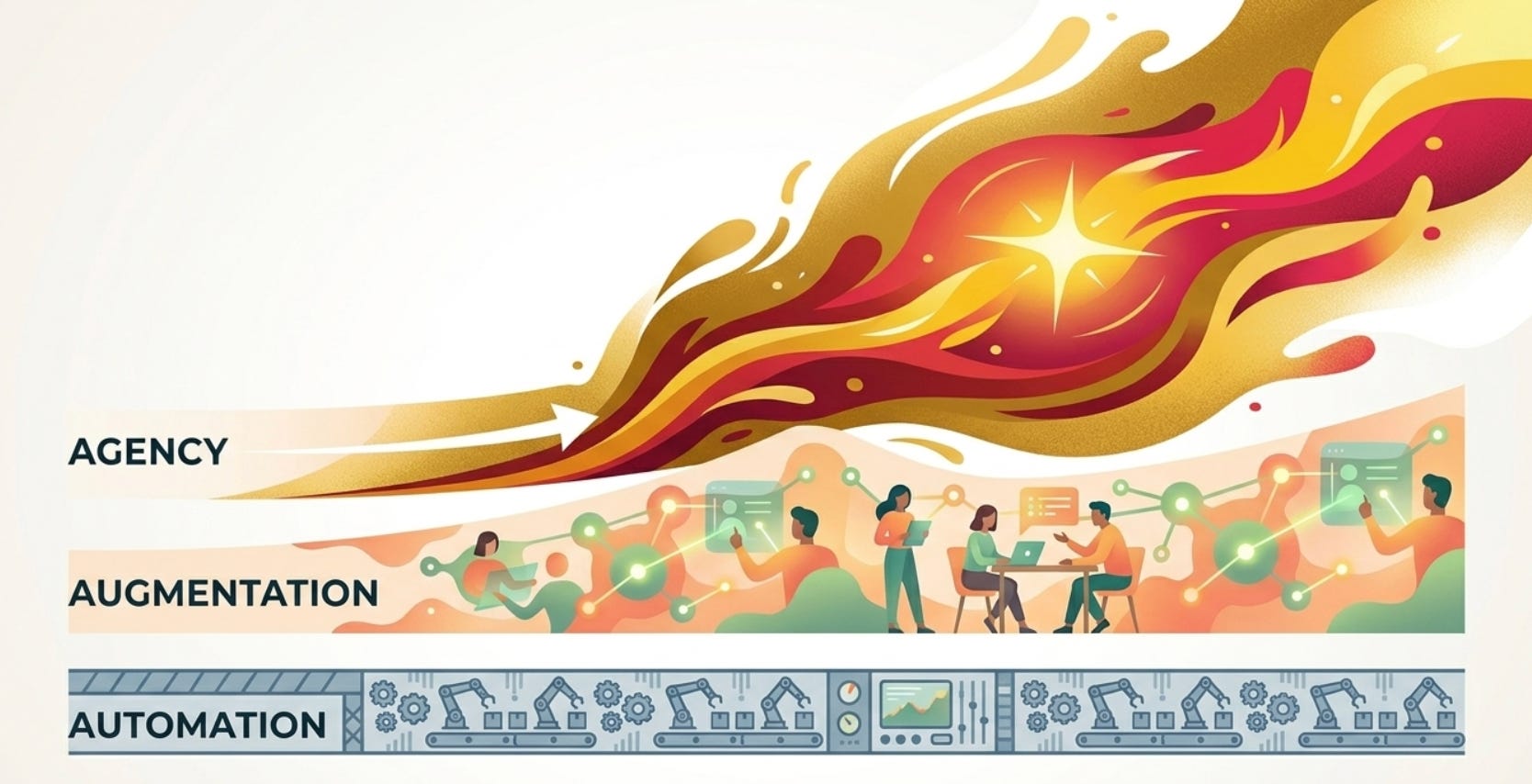
In January 2025, professors Rick Dakan and Joseph Feller published version 1.1 of their Framework for AI Fluency. It’s a practical guide to the human competencies needed to work with AI effectively, efficiently, ethically, and safely. The framework identified three modalities of human-AI interaction: Automation, Augmentation, and Agency. It organized the human skills required across four competencies it called “The 4 Ds”: Delegation, Description, Discernment, and Diligence.
I’ve been applying the framework in my own work for the past year. It has held up remarkably well as a mental model. The 4 Ds are still the right competencies. The three modalities still describe the landscape accurately. But something has happened in the fourteen months since that document was written that the authors could not have fully anticipated: Modality 3, Agency, has exploded.
When the framework was published, the Agency modality, where humans configure AI to perform tasks independently, was the most speculative of the three. Its examples were chatbots, interactive game characters, and tutors. Reasonable examples for early 2025. But the pace of development in agentic AI over the past year has been so fast that Agency has moved from being the least-used modality to the one that increasingly defines how organizations interact with AI.
This article looks at what changed, why it matters, and what it means if you’re trying to build AI-fluent teams.
The world the framework described
To appreciate how much has changed, it helps to remember what the AI landscape looked like in January 2025. ChatGPT was two years old. Claude, Gemini, and Copilot were established products but they were primarily chat interfaces. You asked a question or gave a task and the AI responded. Most professional use fell into Modality 1 (Automation), things like drafting emails, summarizing documents, generating social media posts, or Modality 2 (Augmentation), collaborating iteratively on a research paper or working through a complex coding problem step by step.
Modality 3, Agency, was the forward-looking piece. The framework described it as the human configuring AI to “independently perform future tasks on behalf of the user,” requiring “sophisticated understanding of AI capabilities and limitations.” But the examples reflected a world where agency meant building a simple automated workflow. The idea that AI would soon be writing production code autonomously, managing multi-step business processes end to end, or operating as a genuine team member in enterprise workflows was still theoretical.
That theoretical future arrived faster than almost anyone expected.
What changed: the year of the agent
Several developments converged in 2025 to transform Agency from a niche modality into the dominant trend in enterprise AI.
Agentic coding went mainstream
The most visible shift was in software development. Anthropic released Claude Code in February 2025 as an agentic command-line tool and by July was reporting a 5.5x revenue increase driven by enterprise adoption. By early 2026, the VS Code extension alone was seeing 29 million daily installs, up from 17.7 million in January. GitHub integrated Claude and OpenAI’s Codex into Copilot for Business and Pro users, giving developers the ability to choose which AI model drives their agentic coding workflows.
These are not autocomplete tools. They are agents that read codebases, plan implementations, write and test code, and iterate on failures. Often producing working solutions with minimal human intervention.
Then Anthropic took it a step further. In January 2026, they launched Claude Cowork, bringing the same agentic architecture that powered Claude Code to non-developers. Cowork doesn’t chat with you. It works on your actual files, on your machine, and delivers finished outputs. Spreadsheets with working formulas and research synthesized from multiple sources. Claude chat was how we get answers, Claude code is how developers build software and Cowork is how everyone gets work done. That’s three modality shifts inside a single product line in under a year.
Enterprise agents arrived at scale
The shift wasn’t limited to engineering. Gartner predicted in mid-2025 that 40% of enterprise applications would feature task-specific AI agents by 2026, up from less than 5% at the start of 2025. That prediction appears to be tracking accurately. Microsoft’s Copilot Wave 3 released in early 2026 embedded multi-model agents directly into the Microsoft 365 ecosystem, allowing organizations to build custom agents in Copilot Studio using Claude or GPT as the underlying model. Salesforce, ServiceNow, and other enterprise platforms followed similar paths.
The numbers tell the story. Gartner reported a 1,445% surge in inquiries about multi-agent systems between Q1 2024 and Q2 2025. The global AI agent market crossed $7.6 billion in 2025. Early adopters are consistently reporting 20-30% faster workflow cycles and significant cost reductions in back-office operations.
The democratization of agent building
This might be the most consequential shift for the AI Fluency Framework. Building agents is no longer an engineering-only activity. Low-code and no-code platforms for agent creation have proliferated, putting Modality 3 capabilities into the hands of business users, marketers, operations managers, and analysts. When the framework was written, configuring an AI agent implied deep technical skill. Today, a marketing manager can build a multi-step research agent using drag-and-drop tools and a finance team can configure autonomous reconciliation workflows without writing a line of code.
Nothing illustrates this better than OpenClaw. An open-source AI agent built by an independent developer that hit 247,000+ GitHub stars in 60 days, faster than React accumulated in a decade. OpenClaw runs locally on your machine and connects to your messaging apps. WhatsApp, Telegram, Discord, Slack. You tell it what you need and it executes: managing files, sending emails, browsing the web, running shell commands, automating workflows across applications. People are using it to build meal planning systems in Notion, deploy Laravel apps from their phones, and automate entire research pipelines while they sleep. Jensen Huang called it “probably the single most important release of software, probably ever.” Whether or not you agree with that, the signal is clear: the barrier to building a personal AI agent has dropped to near zero.
This has blurred the lines the framework drew between modalities. The same person might use Modality 1 to generate an email, shift to Modality 2 to co-author a strategic document, and then configure a Modality 3 agent to monitor and report on a data pipeline. All within the same morning. The framework always acknowledged that practitioners move between modalities but the speed and frequency of these transitions has accelerated dramatically.
What this means for the 4 Ds
The beauty of the Dakan-Feller framework is that it was designed to be platform and technology agnostic. The four competencies don’t need to be replaced. But the weight and complexity of each has shifted as Agency has expanded.
Delegation: now the hardest competency
In early 2025, Delegation was primarily about choosing the right tool for a task. Today it’s about designing the right system of agents, workflows, and human checkpoints for an entire process. The sub-category the framework calls “Task Delegation,” balancing AI and human capabilities throughout a project, has become exponentially more complex. Leaders now face decisions like: should this process be a single agent, a multi-agent pipeline, or a human-in-the-loop workflow? Which steps require human review and at what cadence? How do you delegate when the agent itself can delegate to sub-agents?
Platform Awareness, another Delegation sub-category, has also grown more demanding. In January 2025, the choice was typically between a handful of chat-based AI tools. Today an enterprise might be running Claude Chat for quick questions, Claude Code for engineering work, Claude Cowork for knowledge worker tasks, GPT through internal APIs, specialized coding agents in VS Code, and autonomous workflow agents through platforms like Zapier or Make. All simultaneously. Understanding what each agent can and cannot do, and how they interact, is a competency that didn’t exist at this complexity a year ago.
Description: from prompts to system design
The framework’s Description competency was already nuanced, distinguishing between Product Description (defining desired output), Process Description (iterative collaboration), and Performance Description (defining future behaviors). The last sub-category has become the one that matters most in an agentic world. Describing how an agent should behave across a range of scenarios, how it should handle edge cases, what it should escalate versus decide independently, and how it should interact with other agents. This is system design, not prompt engineering.
For business leaders this means the skill of “writing a good prompt” is necessary but increasingly insufficient. The people who create the most value with AI are those who can articulate not just what they want the AI to produce right now, but how they want it to behave across future scenarios they haven’t encountered yet. This is a fundamentally different cognitive skill. It’s closer to writing a job description or designing a workflow than to giving an instruction.
Consider how fast the tooling has shifted. A year ago, if you wanted to automate a multi-step workflow, you opened n8n or Make and manually connected nodes. You dragged an API trigger here, a data transformation there, wired up a Slack notification at the end. It was powerful but it was still you doing the system design visually, one connection at a time. Now the agent builds the workflow itself. You describe the outcome you want and the AI figures out which tools to connect, in what order, with what logic. The Description competency hasn’t gone away. If anything it’s more important. But what you’re describing has shifted from “connect these three nodes” to “here’s how I want this system to behave when things go wrong at 2am.”
Discernment: evaluating systems, not just outputs
When AI produces a single email or document, evaluating its quality is straightforward. When AI agents are managing multi-step processes autonomously, Discernment becomes a monitoring and auditing discipline. The framework’s Performance Discernment sub-category, evaluating whether AI-driven independent behaviors enable positive user experiences, is now a daily operational concern for any organization deploying agents.
The challenge gets harder with multi-agent systems where the output of one agent feeds into another. Discernment now requires the ability to trace decisions through a chain of automated steps, identify where quality degrades, and determine which agent in a pipeline needs adjustment. This is observability thinking applied to AI. A competency borrowed from DevOps that has become essential for any team running agentic workflows.
Diligence: the stakes have risen
The framework was already ethics-centered but the urgency around Diligence has intensified. When an AI drafts an email that a human reviews before sending, the blast radius of error is limited. When an autonomous agent is processing claims, updating customer records, or writing and deploying code, the blast radius is organizational. Deployment Diligence, taking responsibility for AI-assisted outputs and implementing safety checks, has moved from a best practice to a business-critical function.
Transparency Diligence has also become more complex. When a team collaborates with an AI chatbot, the human contribution is clear. When an agent autonomously produces and distributes a report, the question of disclosure gets murkier. Organizations need clear policies on when and how to disclose AI involvement. And those policies need to account for a spectrum of autonomy that didn’t exist when the framework was written.
What leaders should do now
Having applied this framework through the agency explosion, I’ve landed on several practical recommendations.
Start training for systems.
Most corporate AI training programs are still focused on Modality 1. Here’s how to write a prompt, here’s how to summarize a document. The competitive advantage has moved to people who can design, configure, and govern multi-step agentic workflows. Your AI fluency programs need to teach system thinking, not just tool use.
Build Discernment into your operational rhythm.
As agents take on more autonomous work, your team’s ability to evaluate that work must keep pace. This means building review cadences for agentic outputs, investing in observability tools for AI workflows, and creating clear escalation paths for when agents produce results that need human judgment. Discernment can’t be an afterthought. It needs to be embedded in the operating model.
Audit your Delegation maturity.
Look at how your organization is currently using AI. If the vast majority of use is in Modality 1, simple automation, you have a significant opportunity gap. The teams that are pulling ahead are the ones operating fluently across all three modalities, especially those leveraging Agency to create compounding productivity gains. Map your current use against the three modalities and identify where your gaps are.
The framework holds, with a new center of gravity
The AI Fluency Framework has proven itself as exactly what its authors claimed. A platform-agnostic, contextual, and flexible tool for thinking about human-AI interaction. The 4 Ds remain the right lens. The three modalities remain the right categories. What has changed is the center of gravity. A year ago most organizations were operating primarily in Modality 1, with the more advanced teams exploring Modality 2. Today Modality 3 is where the most consequential decisions and the greatest risks are emerging.
Dakan and Feller noted in their original document that it was a living framework, designed to evolve. The version 1.5 update and an Anthropic-backed open course have already extended its reach. But for business leaders the core message has sharpened. AI fluency is no longer about learning to use a chat tool. It’s about developing the judgment to configure, govern, and take responsibility for AI systems that operate with increasing autonomy.
The organizations that thrive in this environment won’t be the ones that adopted AI first. They’ll be the ones that built fluency deepest. Especially in the competencies that matter most when the agents are running on their own.
Sources & Further Reading
Dakan, R. & Feller, J. (2025). Framework for AI Fluency: Practical Overview Document, Version 1.1. Ringling College of Art and Design / University College Cork.
Gartner (2025). “Gartner Predicts 40% of Enterprise Apps Will Feature Task-Specific AI Agents by 2026.” Press Release, August 2025.
Deloitte Insights (2026). “Agentic AI Strategy.” Tech Trends 2026.
IBM (2025). “AI Agents in 2025: Expectations vs. Reality.” IBM Think.
The Conversation (2025). “AI Agents Arrived in 2025 – Here’s What Happened and the Challenges Ahead in 2026.”
Microsoft 365 Blog (2026). “Powering Frontier Transformation with Copilot and Agents.”
National Forum for the Enhancement of Teaching and Learning (2025). “Launch of New Open Course: AI Fluency – Framework and Foundations.”
The shift toward AI agency is a real turning point, looking forward to reading the full piece.
Strong framing on the shift from tools to agency. One thing that helped our team turn this from “interesting” to operational was keeping a 5-line run receipt after each agent run (goal, tool calls, failure point, recovery step, next test). It made handoffs cleaner and cut repeat debugging fast. If useful, I share practical OpenClaw run breakdowns with that exact structure here: https://substack.com/@givinglab